+++
Την Ελληνική μας σελίδα θα την βρείτε εδω http://mki-ellinikou.blogspot.com/ +++


Showing posts with label public health system. Show all posts

Sunday, November 24, 2013

…as from today we are all Greeks


Press Release
“…as from today we are all Greeks

On Tuesday, 5 November 2013 the cardiologist Dr. George Vichas, representing MCCH was officially invited to participate in the conference “Responding Together” organized by the Council of Europe jointly with the European Union.  Dr. Vichas participated in a workshop “How to create incentives to avoid waste and promote a better use of resources.”  He answered numerous questions on the organization and operation of the Metropolitan Community Clinic, the plight of the uninsured and those cut off from public health and the impact on the health of patients excluded from the public health system in our country.

His description of the situation in Greece today included the difficulty that even the insured experienced to afford a doctor or the medicines prescribed.  Often the medications are not available.  Dr. Vichas mentioned pregnant women who couldn’t find a hospital bed to give birth and who had received little or no pre-natal care.  He described cancer patients losing time in getting treatment and the often tragic result of uninsured patients who require hospitalization and advanced care.

He showed clearly and made the audience realize that the policies that are being followed at present are criminal and there are people who will one day have to answer for them.  It is not a time for complacency for European citizens who must realize by now that such policies are being deployed in many European countries.

Finally Dr. Vichas, one of the founders of MCCH, pointed out what for thousands of years Greeks have known; that when there is no political will to abolish a policy that is really criminal, we the people abolish it ourselves and take action to clearly show that we reject such a law.  He then stated “be sure that is what we do today” in doing our utmost to help those who are cut off from the public and national health systems.”

The reaction at the meeting was immediate.  There was a lot of interest and even anger.  Finally a lawyer from the European court wanted urgently to take the Greek case to the court.  But the president of the meeting selected only three of the many examples that had been voiced by Dr. Vichas to be studied at the higher levels of the European Committee and the European Parliament.


The most touching moment for our doctor was when, at the end of the meeting, he was surrounded by the members who approached him and said to him, with evident emotion, “As from today, we are all Greeks”


METROPOLITAN COMMUNITY CLINIC AT HELLENIKO 

  Working Hours
(MONDAY-FRIDAY 10:00-14:00) (MONDAY 17:00-20:00) 
(TUESDAY 14:00-20:00) (WEDNESDAY 16:00-20:00) (THURSDAY 14:00-20:00)
(FRIDAY 14:00-19:00) (SATURDAY 10:00-14:00) 
CONTACT PHONE NUMBER: +30 210 9631950 
ADDRESS: Inside the old American Military Base, 200m away from the Traffic Police of the Municipality of Helleniko, next to the Cultural Center of Helleniko
Post code TK16777, Elliniko, Attiki, Greece 
Blog 
http://mkie-foreign.blogspot.gr/ Email mkiellinikou@gmail.com

Tuesday, October 22, 2013

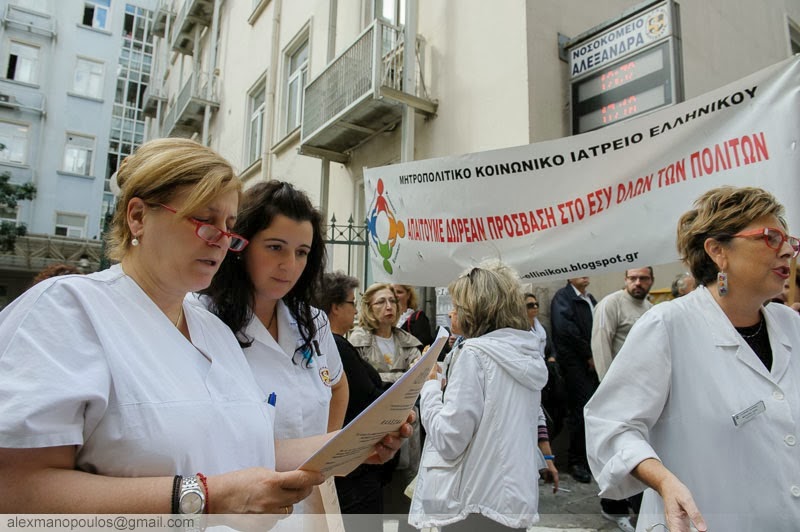
The Protest at Alexandra Hospital was a Great Success


The Protest at Alexandra Hospital was a Great Success

A peaceful protest at the entrance of the Alexandra Hospital was successfully carried out on 17 October 2013.  The day was the day of action of the Volunteer Community Clinics and Pharmacies in hospitals all across the country.  Participating in the action were The Metropolitan Community Clinic at Helliniko, The Community Clinic and Pharmacy for Solidarity of Athens, Society of Cancer Patients, Volunteers, Friends and Physicians (KEFI) and The Team for Solidarity for those with Muscular Sclerosis.

The protest was to give a strong voice to women’s organizations, and the movement “I will not pay”.  Doctors and nurses of the hospital and as well as our patients and private citizens, took part. The goal of the protest was to demonstrate, yet once again, that all must have equal access to health care including, of course, the uninsured.

A delegation of the protesters participated in a meeting with the assistant director of the hospital.  She gave a personal undertaking that the hospital will accept, from here on, uninsured pregnant women who will be able to give birth with dignity and that there will be no cost passed on to them, or costs passed on to their tax debt.  This is a significant step in our battle to open the state hospitals to all uninsured citizens.  This, the state is obligated to do, but does not do it.  But the employees of the hospitals, in solidarity with simple citizens, are doing what they can to honor this obligation.

We gave a clear message of the inalienable right of all to LIFE and DIGNITY.  We have asked for a written answer the hospital’s undertaking.  We will continue our struggle with the same unwavering firm stance that ALL HAVE A RIGHT TO LIFE.    


Friday, October 11, 2013

Press Conference by the Coordinated Voluntary Community Clinics and Pharmacies of Attika


PRESS RELEASE
Press Conference by the
Coordinated Voluntary Community Clinics and Pharmacies of Attika
Monday, 14 October


We, the doctors, pharmacists, social workers, psychologists and all the volunteers who organize and work in the community clinics and pharmacies for solidarity in Attika have a number of questions to put not only to the Minister as Health, but the entire government as well.  The questions are:  

  1. How many people, who as a result of unemployment and the four-year economic crisis have lost access to primary health care?

  2. Is 1/3 of the population uninsured and therefore without access to the secondary health system (hospitalization)?

  3. How many uninsured cancer patients have been excluded from access to chemotherapy and radiation therapy, thereby endangering their chances of survival?

  4. How many long term patients have had their rights to kidney dialysis, blood transfusion and other essential treatments and medication for their conditions terminated?

  5. How many patients with common long term ailments, such as diabetes, diabetes mellitus, hypertension, high cholesterol, have cut their therapy with tragic consequences to their health?

  6. How many women have been denied the right to give birth with dignity and with proper care because they cannot pay the expenses of the formerly cost-free public health system?

  7. For what reason are medical expenses for immigrants doubled?

 
We invite the government to answer the questions above.  Until then, in resistance to the barbaric status quo, we of the voluntary community clinics and pharmacies will battle to preserve our society, our dignity and our hope.  We keep faith in community solidarity and hold the conviction that health is the highest social good.  Our actions are not acts of charity, nor do we wish to give the message that people should quietly submit and act out of compassion.  Rather, together we struggle for the right to public health and to reclaim cost-free access to medical care for all.
 
We invite you on Monday 14 October 2013 to a press conference sponsored by the Coordinated Voluntary Community Clinics and Pharmacies of Attika.  The press conference will be held at the Journalists Union of the Daily Newspapers of Athens, Acadamias 20, Athens.

 
Coordinated Community Clinics and Pharmacies for Solidarity, Attika
 
-Solidarity Clinic of Piraeus
 
-Metropolitan Community Clinic at Helliniko
 
-Community Solidarity Clinic and Pharmacy of Athens
 
-Community Solidarity Clinic of Peristeri
 
-Community Clinic Filis
 
-Community Solidarity Pharmacy of Patisia
 
-Community Clinic of Agia Varvara (being established)
 
-Community Network of Doctors and Pharmacists of Iliou and the Solidarity Community Pharmacy of Iliou
 
-Network of Doctors of Kifissias/ Nea Erithraias
 
-Psychological support Network of Community Solidarity Artemidas-Spaton
 
-The Manolis Gereanos “Solidarity for All” Health Team
 
-Society of Cancer Patients, Volunteers, Friends and Physicians


METROPOLITAN COMMUNITY CLINIC AT HELLENIKO

  Working Hours
(MONDAY-FRIDAY 10:00-14:00) (MONDAY 17:00-20:00) 
(TUESDAY 14:00-20:00) (WEDNESDAY 16:00-20:00) (THURSDAY 14:00-20:00)
(FRIDAY 14:00-19:00) (SATURDAY 10:00-14:00) 
CONTACT PHONE NUMBER: +30 210 9631950 
ADDRESS: Inside the old American Military Base, 200m away from the Traffic Police of the Municipality of Helleniko, next to the Cultural Center of Helleniko
Post code TK16777, Elliniko, Attiki, Greece

Blog http://mkie-foreign.blogspot.gr/ Email mkiellinikou@gmail.com

Sunday, October 6, 2013

A Denunciation by the Voluntary Community Clinics and Pharmacies of Attika and Organizations of Solidarity for Health in Attika


PRESS RELEASE
A Denunciation by the Voluntary Community Clinics and Pharmacies of Attika and Organizations of Solidarity for Health in Attika

The Volunteer Community Clinics and Pharmacies of Attika and Organizations of Solidarity for Health condemn the ongoing brutal policies of the Greek government in the area of health. The criminal barring of the uninsured to cost-free health services – both primary and hospital care - leads to the disability and death of thousands of our fellow citizens who cannot cope with the cost of care. They often seek treatment too late, after their health has seriously deteriorated.

The VCCP of Attika protests the closure of eight hospitals in Athens and Salonika, and the plans to eliminate even more hospital departments and patient-beds in the countryside. This is being done by the Ministry of Health in order to meet commitments made as a result of the “the memoranda”. That is, the agreement Greece has made with its lenders that drive the austerity measures in this country. 

We also protest the transferring and the firing of thousands of health workers at a time when they are more necessary than ever. We want to emphasize that State Hospitals are all but closed for the 30% and more of the population who are without insurance, and have been for the past three years. 

For the uninsured to be hospitalized (this includes the unemployed, the poor, immigrants without legal papers, small shop owners who can’t pay the 450€ per month to their social security funds, as well as the entire gray and black world of people working “off the books”), they must pay the entire cost of the hospitalization, including medication. These amounts can reach tens of thousands of euros and can of course go much higher with serious illnesses – such as cancer.

The highly publicized voucher system for the uninsured and the “free distribution of medication” are band-aid programs and don’t begin to address the needs of all excluded from the health care system.  

The shutout of the uninsured, together with the ever increasing co-payments for care from the uninsured, the closure of hospitals and the closure of health facilities and reduction of patient beds, the layoffs and transfer of health workers and the functional destruction of the remaining hospitals due to under-funding, and suspension of recruitment are part of a uniform policy to meet austerity commitments. But all of these things and more mean, in essence, that the right to health care is, for all practical purposes, abolished.

Those setting these policies envision a more commercialized health system operating in parallel with the for-profit private health care sector. It might sound like a good idea, but we are seeing tragic results in lives lost and the fundamental deterioration of the health of thousands of our fellow citizens

Ruining the health system and turning it from a social blessing to a commercial enterprise is the hardening crust as the memoranda policies materialize more and more and solidify beneath it into the harshest financial austerity the working population of Greece has ever known. The 40% cut-back of expenses for public health (in relation to GDP), cuts on programs directed to help public health, disease prevention, promote hygiene and help needy citizens – they all now show clearly the negative effects they are having on our social and political well-being. We, who are daily confronted by an explosive need for health services, know all too well that it is so.

Behind every statistical fact, there are human beings. Amazing facts, such as the increase of HIV infections by 200%, the increase of malaria, the shortage of drugs, 40% of the population without public health – behind all this, we perceive daily personal and family tragedies, exhaustion, hopelessness and human misery. So we, the people who see all this clearly in ALL the volunteer clinic of solidarity declare in a unanimous, unfaltering and strong voice, “NO, SUCH CONSEQUENCES, WERE NOT INEVITABLE and needn’t have happened”. 

Such miserable results were not inevitable and may not even be legal; they are the result of political Austerity. It is our duty, in this hour of need, as victims of such policies, to struggle, united and determined to reverse all this and demand public health care, as a non-negotiable right. It has a primary value and not to be haggled over, not for economic reasons, work conditions, legalities, religious or nationalistic sensitivities or age. Today, any hesitation to take the initiative of support and solidarity, any half-hearted solution that looks the other way from people we lose EVERY DAY, just prolongs such criminal policies in which the life of an individual is not worth the price of a ticket.

The Volunteer Community Clinics for Solidarity who by their existence strive to keep alive the concept of free care and support the victims of these policies, denounce the exclusion of uninsured patients from public health care and the dismantling and commercialization of the public health care system. We call for a sustained and united struggle to insure a free and public health and welfare system for all residents of this country, without exception.

-Solidarity Clinic of Piraeus

-Metropolitan Community Clinic at Helliniko

-Community Solidarity Clinic and Pharmacy of Athens

-Community Solidarity Clinic of Peristeri

-Community Clinic Filis

-Community Solidarity Pharmacy of Patisia

- Community Clinic of Agia Varvara (being established)

-Community Network of Doctors and Pharmacists of Iliou and the Solidarity Community Pharmacy of Iliou

-Network of Doctors of Kifissias/ Nea Erithraias

-Psychological support Network of Community Solidarity Artemidas-Spaton

-The Manolis Gereanos “Solidarity for All” Health Team


METROPOLITAN COMMUNITY CLINIC AT HELLENIKO

  Working Hours
(MONDAY-FRIDAY 10:00-14:00) (MONDAY 17:00-20:00) 
(TUESDAY 14:00-20:00) (WEDNESDAY 16:00-20:00) (THURSDAY 14:00-20:00)
(FRIDAY 14:00-19:00) (SATURDAY 10:00-14:00) 
CONTACT PHONE NUMBER: +30 210 9631950 
ADDRESS:
Inside the old American Military Base, 200m away from the Traffic Police of the Municipality of Helleniko, next to the Cultural Center of Helleniko
Post code TK16777, Elliniko, Attiki, Greece

Blog http://mkie-foreign.blogspot.gr/ Email mkiellinikou@gmail.com

Thursday, September 26, 2013

Are the benefits substantial or is it only about pure announcements of the Ministry of Health? Are the community clinics the target?


PRESS RELEASE

"Are the benefits substantial or is it only about pure announcements of the Ministry of Health? Are the community clinics the target?”


After two (2) years of silence, the Ministry of Health suddenly decided, end of August 2013, to introduce a new program for citizens who had no social security and had been left to their fate, namely the “health voucher”. The program applies to a small portion of uninsured citizens i.e. about 230,000 people. With duration of only two years, it offers a limited range of primary health care services – which are also docked – excluding any plan for the provision of medicines, the coverage of potential expensive medical examinations or the secondary health treatment in hospitals e.t.c.
All of a sudden, again, the Ministry of Health revealed on the 10th of September a signed cooperation pact with the Medical Association of Athens (MAA), the Hellenic Association of Pharmaceutical Companies (SFEE) and the Archdiocese, where it is agreed to provide poor and uninsured citizens with free medicines close to expiration date.
At the same time, hospitals in the country are closing, thousands of employees among doctors and the nursing stuff do not know if they will continue to be occupied; the Greek National Organization for Healthcare Provision is walking the tightrope, and no one knows whether it will continue to exist- at least in its today miserable state- or if it will become a mini contractor to distribute the healthcare services, people with health coverage are entitled, to private institutions. 
The Ministry of Health owes to fight for a solution to cover the weakest social groups as a total.  What it does instead today, is preannouncing programs that cover only a small portion of uninsured and poor citizens, followed by the involvement of the pharmaceuticals to provide them (as reported in the interview) with medicines six months before their expiration date, that is, medicines they can not distribute to the market.
We always quote examples, so, at this point, we would like to remind you of one of the most serious cases we have experienced with regard to the Ministry of Health: cancer patients, with no healthcare coverage were excluded from the Greek Public Health System and had been abandoned to their fate, till last year, when they took a breath of life and gained new hope for life in the oncology clinic of the Sotiria hospital. This was achieved thanks to the employees, who opened the gates of the hospital to the uninsured cancer patients, that is, they did ON THEIR OWN what the STATE REFUSED to do.  The question now is: Will the UNIQUE clinic that is open to the UNINSURED patients continue to operate? We hope that the new announcements will not have any impact on the Sotiria clinic’s operation. But, if our fears are verified, we would like to make clear that we will not give our consent. In such an unpleasant case, we are ready to inform and motivate all citizens to react with all means.  
Our doubts are substantiated by the  fact that the Ministry of Health has repeatedly lied in the past by claiming that all uninsured citizens have access to the Public Health System
(watch the video
http://www.youtube.com/watch?v=VlXLLYopTsY with the former minister Andreas Lykourentzos as well as the following video http://www.youtube.com/watch?v=eCT8B31x7U4 with the Representative of the Greek Ministry of Health, Mr. Panos Eustathiou).  Their false statements are proven by the poor measures they are taking. This is why citizens are wondering now about the Ministry of Health’s exact intentions in view of the introducement of the latest half measures. 

We, as a community clinic, continue to demand FREE access to the Greek National Health System for all citizens. Whoever attempts to cut down the right of all citizens for health, with the excuse of the semi-free access, or attempts to shut down the community clinics, and cut off the possibility of assisting the society in such crucial times, will surely find us against him. The community clinics constitute a LAST RESORT and do not aspire to give ground to political confrontations or the promotion of anybody’s political pursuits. 
Whoever attempts to take undue advantage of the solidarity and tries to use it against citizens will find us against him. We, as a community clinic, will not only intensify our fight, but we will also fight against the homicidal laws and policies in Health.


METROPOLITAN COMMUNITY CLINIC AT HELLINIKON

OPERATING HOURS 
(MONDAY-FRIDAY 10:00-14:00) (MONDAY 17:00-20:00)
(TUESDAY 14:00-20:00) (WEDNESDAY 16:00-20:00) (THURSDAY 14:00-20:00)
(FRIDAY 14:00-19:00) (SATURDAY 10:00-14:00)
TELEPHONE:
210 9631950
Located within the former U.S. Air Force base (next to the Cultural Centre of Hellinikon, 200m away from the Traffic Police)
Blog
http://mki-ellinikou.blogspot.com Email mkiellinikou@gmail.com

Are we with the Darkness or the Light?


PRESS RELEASE
Are we with the Darkness or the Light?


In the 20 months of MCCH’s operation we have published numerous stories of the grim reality people face today who have no money or insurance and who have serious health problems.  They make for heavy reading.  People shut out of the public health system; one wonders why the public prosecutor has not intervened.  
Today, we want to tell the world a profoundly human story.
On Monday, 16 September, a volunteer doctor at our clinic found an elderly woman waiting for him, her eyes swollen with tears.  The woman said “Doctor, you are my only hope.” 
Her 23 year old grandson is uninsured and suffers from chronic myelogenous leukemia.  The treatment is the medication GLIVEC; the cost is around 2,000 euro a month.
She was searching for hope; the poor family could not begin to cover the costs to maintain the young man’s life.  The life of the 23 year old was in imminent danger; for several days he had not had access to medication and was not able to follow the required therapy.
Today, a young man is endangered because the numbers don’t work out at the Ministry of Economy and the Ministry of Health.  It’s an “accounting problem” a spokesman at the Ministry of Health answered us a short while ago, regarding another cancer patient of ours.
We are pounding on the door at the Ministry of Health once more and ask “Are you going to let this 23 year old young man die?”
The Ministry of Health is silent on the subject.  But in only one day his medication was secured for him for a month – and in a profoundly heartwarming way, a profoundly humbling way.
We announced the problem.  Two patients who are receiving the same treatment decided to give up some of their own medication.  Once gave ten pills, and the other twenty, so that the young uninsured man could have a month’s respite.  Life for one month!  That is the essential, the magnificent message of SOLIDARITY.
A patient gives up extremely expensive medicine for another, cutting off a bit of the thread that keeps him alive.  How humbling and how moving is it to hear from a cancer patient “take some of these pills from mine.”  At the same time, the Ministry of Health answers “It’s an accounting problem.”
For the umpteenth time, we wonder, if this situation was to befall one of their children, what would the decision makers at the Ministry do?
And more importantly, where are our leaders?  With the darkness, or with the light of life?

METROPOLITAN COMMUNITY CLINIC AT HELLENIKO

  Working Hours
(MONDAY-FRIDAY 10:00-14:00) (MONDAY 17:00-20:00) 
(TUESDAY 14:00-20:00) (WEDNESDAY 16:00-20:00) (THURSDAY 14:00-20:00)
(FRIDAY 14:00-19:00) (SATURDAY 10:00-14:00) 
CONTACT PHONE NUMBER: +30 210 9631950 
ADDRESS: Inside the old American Military Base, 200m away from the Traffic Police of the Municipality of Helleniko, next to the Cultural Center of Helleniko
Post code TK16777, Elliniko, Attiki, Greece

Blog http://mkie-foreign.blogspot.gr/ Email mkiellinikou@gmail.com

Thursday, August 22, 2013

Una clínica social en Grecia atiende a los pacientes que pierden la cobertura gratuita

*article in spanish published on eldiario.es

Clinica Social Helliniko
Exterior de la Clínica Social de Helliniko, ubicada en la antigua base militar americana / Susanna Arús y Blanca Blay
Cinco personas esperan en recepción mientras los administrativos abren fichas y conciertan las próximas visitas. Ninguno de ellos tiene cobertura médica gratuita. En el sistema de salud pública de Grecia, a diferencia de España, uno pierde su cobertura cuando lleva más de un año en el paro. Por si no fuera suficiente con el drama del desempleo en el país, los principales sindicatos de médicos calculan que cerca de un millón y medio de personas no tienen actualmente acceso a los servicios del Sistema Nacional de Salud. Sin ningún tipo de seguro y a menudo sin los recursos económicos para pagarse una visita, medicamentos para un tratamiento o incluso una operación, algunos de estos ciudadanos se ven acorralados y su salud se ve amenazada.
Doctor Giorgios Vichas
El doctor Giorgios Vichas en una de las consultas de la clínica / Susanna Arús y Blanca Blay
Giorgos Vichas, un veterano cardiólogo del EOPYY - el mayor proveedor de servicios médicos públicos en Grecia-, se empezó a dar cuenta de ello. "Algunos de mis pacientes dejaron de visitarme porque habían perdido su cobertura y no podían pagarse las consultas o los medicamentos que yo les recetaba", explica. Con la vocación sobre sus hombros decidió encontrar una manera de ayudarles así como a otras personas que también se habían quedado sin seguro. Así fue como le surgió la idea de montar una clínica social, donde él y otros profesionales del mundo sanitario trabajarían como voluntarios. Dos años después, esta idea es una realidad. La Clínica Social Metropolitana de Helliniko, ubicada en una antigua base militar americana en esta municipalidad, atiende una media de 70 personas al día. "La mayoría de ellos - afirma Vichas- son gente de clase media que hace un año tenían una vida muy digna pero que se quedaron sin trabajo".
El doctor llama a uno de los cinco pacientes que esperan en la recepción de la clínica. Govostis Stamatis, camarero de profesión y desempleado desde hace cinco años, entra en la consulta. Padece diabetes y necesita tratamiento a diario así como realizar chequeos médicos de forma regular. "Sin la ayuda de la clínica ahora mismo estaría muerto" explica, tras recordar el día en que, "avergonzado, decidí acudir a la Clínica Social en Helliniko". Sus niveles de azúcar estaban disparados, podían producirle un coma, y le derivaron urgentemente al hospital público Sotiria. Allí le trataron pero cuando la persona del departamento de finanzas apareció para preguntarle cómo iba a pagar por la medicación se sintió atrapado. "No tenía trabajo ni dinero y el doctor Vichas se involucró personalmente para solucionar la situación", dice Govostis. En ocasiones son los mismos doctores y voluntarios quienes ejercen de mediadores entre los pacientes y las oficinas de gestión de finanzas de los hospitales. En casos extremos, han llegado a acompañar a sus pacientes a la farmacia y pagar de sus bolsillos los medicamentos.
El espacio donde ahora el doctor atiende a Govostis es propiedad del estado. Estaba "en venta" y se había especulado sobre la construcción de un casino, pero después de que Giorgos Vichas hablara con el alcalde de Helliniko, el futuro de la base ha sido otro. La clínica es hoy ampliamente conocida en el municipio y el ayuntamiento cubre los gastos de los distintos suministros de ésta. Por otro lado, el material, desde muebles hasta equipo técnico sanitario, lo han conseguido gracias a las donaciones de otros profesionales del sector privado que les han cedido tras jubilarse.
Por turnos y con un horario que se adapta a su disponibilidad, unos 230 voluntarios -90 de ellos personal médico- se han volcado a esta iniciativa. Cualquier ayuda es bien recibida, desde atención de llamadas, clasificación de medicamentos o gestión de la página web, hasta transporte de material. Uno de estos voluntarios, Eleni Gerakari, estudió económicas y en su tiempo libre acude a la clínica para ayudar con los servicios de comunicación y visitas de la prensa. Hablando un inglés perfecto explica como "el número de pacientes se ha incrementado de forma dramática en los últimos meses, por este motivo también se han multiplicado el número de donaciones y han llegado aún más voluntarios".
voluntario Panos Papadopoulos
Panos Papadopoulos ayuda de forma voluntaria en el almacenamiento de los medicamentos / Susanna Arús y Blanca Blay
Otro de ellos, Panos Papadopoulos, se encarga de gestionar los fármacos que les llegan. Se asegura que no estén caducados, los clasifica y los borra de la lista que desde la web van actualizando sobre el material que necesitan. "La sala donde guardamos los medicamentos es el orgullo de nuestra clínica, al principio tan solo contábamos con un armario, y ahora, la habitación está llena", dice Panos. Mientras, Eleni observa con satisfacción cómo llega una nueva tanda de medicamentos dentro de bolsas de plástico, en las que sobretodo hay productos alimenticios para bebés. "Proveemos ayuda a recién nacidos de cien familias. Se ha llegado a dar el caso en que un hospital público se quedara con un recién nacido hasta que la madre que dio a luz les proveyera con el dinero", comenta Eleni mientras las bolsas se van acumulando en el suelo.
Estos casos no han pasado desapercibidos por el Consejo de Europa, que ha dado la voz de alarma sobre los peligros de la austeridad, especialmente cuando el derecho al acceso a la salud pública está de por medio. En el informe hacen referencia a una "crisis sanitaria y hasta humanitaria que afecta cada vez a más gente, principalmente desempleados, inmigrantes, refugiados, mujeres y niños" y remarcan la situación "especialmente preocupante de las mujeres embarazadas que no tienen cobertura médica y no pueden afrontar los gastos de entre 800 y 1200 euros que reclaman los hospitales tras dar a luz."
Sala de medicamentos
Sala de la clínica donde los voluntarios clasifican y almacenan los medicamentos que les llegan / Susanna Arús y Blanca Blay
El ritmo no cesa en la clínica. Si bien todos están contentos con el trabajo que han hecho y hacen cada día, confían en que la clínica no exista para siempre. "Esperemos que este centro no sea un proyecto a largo plazo, que no sea un sistema de salud paralelo", dice el doctor Vichas. Ahora en la sala de espera sólo quedan cuatro personas, desde la consulta del dentista llaman al paciente siguiente.


Monday, August 12, 2013

The Answer of Laiko Hospital to Our Urgent Appeal for a Cancer Patient


Helliniko 8 August 2013

PRESS RELEASE
The Answer of Laiko Hospital to Our Urgent Appeal for a Cancer Patient

MCCH issued a 2nd press release on Tuesday 6 August 2013 regarding the especially serious failure of Laiko Hospital to provide necessary medication for a 53 year old cancer patient.  Two days later, on 8 August we received the following reply from the hospital.  You will find the full text of the letters below – you can draw your own conclusions.

As The Metropolitan Community Clinic at Helliniko, we are obliged to ask the Ministry of Health and the administration of the Laiko Hospital the following questions.

-    For what reasons does “the pharmacy of Laiko Hospital lacks this particular medication” as Mr. Polyzos states in his letter.

-    The cancer patient in question IS INSURED by “Pronia”, a state welfare scheme.  State hospitals are obliged to give any holder of a health booklet under this plan the medication he or she needs.  This didn’t happen.  Why?

-    We are especially pleased that the company producing the medicine will make it available to our patient.  But what will happen with other patients who find themselves in the same situation?  Where will they get their medication?  Our patient is not the only one who has gotten his prescription for life saving medications back from a state hospital stamped with “this medication not available”.  What must these patients do?  Go from volunteer clinic to volunteer clinic until they find one who will make the fuss that we made in the past week with two press releases?  And what about the psychological damage?  It’s hard enough to fight for your life against cancer.  Can these patients summon the strength to fight the burearcracy as well?  Does anyone in the Ministry of Health lose sleep over what they are doing to these patients? 

-    Will the Ministry of Health finally make provision for these situations and, will they finally answer to what will happen to the tens of thousands of UNINSURED citizens who have no access to the Public Health System.

We emphasize that we deeply respect the doctors, and health care staff of the state hospitals.  They struggle every day to face challenges that cannot be overstated.  They are doing their best to care for their patients while coping with the austerity measures dictated by the Ministry of Health and by most (not all) hospital authorities.

We cannot stand silently by when we see these types of criminal acts every day.  It is mainly the uninsured patients who are suffering, but, as in this case, insured ones as well. 

We have to call them as we see them and demand ANSWERS.  The hospital should NOT try to hide behind a doctor who strives with all his might to care for his patients. 

These answers can come only from the Ministry of Health and the Administrations of each state hospital.  So far, these answers have not been given.


Letter One

Subject: Concerning your urgent appeal for a cancer patient:

In answer to the above, we transmit the message to Dr. Ar. Polyzos (7-8-13), director of our Pathology Department which concerns the 53 year old cancer patient in questions and the medications administered to him.

We are at your disposal for any information you require.

Administrator
Theofani Zervou


Letter Two

Subject: Concerning your appeal to Laiko Hospital about the 53 year old cancer patient who is not insured by EOPYY

The drug in question is made by ROCHE and is unique, there are no generic versions.  For reasons that do not concern the doctors, the pharmacy of our hospital did not have this specific drug.
Since the patient in question is not insured by EOPPY (Greece’s main public health-care provider) their pharmacies cannot provide him with the said medicine.

The administration of our hospital however, borrowed the required drug from another hospital while company making the drug will provide the drug to this particular patient.

The patient will receive his therapy on Friday 9 August 2013

Attending Physician
Professor Aris Polyzos
Director of the A. Pathology Clinic
University of Athens


 Here you can read the original post in Greek, accompanied by the two letters in Greek http://mki-ellinikou.blogspot.gr/2013/08/blog-post_8.html

Wednesday, July 31, 2013

Monitoring Health Issues in Greece


Helliniko 16 July 2013

PRESS RELEASE
Monitoring Health Issues in Greece

The Metropolitan Community Clinic at Helleniko has a well-rounded viewpoint on health problems in this country.  We are going to use that experience as a basis to establish an “Observatory of Health Issues” and document critical health issues in Greece.  The goal is to thoroughly record the problems of the public health system and monitor the relevant indicators in the population. 
While patient care will always be our first goal, some of our volunteers will systematically record not only the relevant news, but also isolated incidents and complaints.  And in documenting these incidents, we will be able to build a complete survey of the situation. 
We invite all concerned citizens to participate and, when they learn of something relevant, to inform us at the e-mail address mkie.paratiritirio@gmail.com.  Please indicate the source of the information (i.e. newspaper, magazine, patient data, etc.)  The information will be verified and posted to the Observatory.
A bi-monthly report will be prepared with all the data and statistics gathered.  We believe that this information is essential due to the exclusion of an increasing number of people from the health services.  The purpose of this initiative is to apply pressure to reverse policies that excludes impoverished citizens from health services.  Additionally there is the possibility of using this data in the future recourse to bodies both in Greece and abroad by citizens who are victims of the policies of the “memorandum.” 
Let’s send the message that the time of impunity is over and the restoration of constitutional legitimacy is at hand.  Every one responsible will be held to account for crimes committed.  The annihilation of our fellow citizens cannot be allowed.  The Council of Europe has undertaken to adopt a resolution regarding the health care of residents in countries where severe austerity measures are imposed. (See link: http://mki-ellinikou.blogspot.gr/2013/07/blog-post.html).
With this initiative, and with our small efforts, we will contribute, as we should, in the monitoring and the implementation of the measures proposed by the Council of Europe for the normalization of health care systems.

Thursday, July 11, 2013

Closure of the Paediatric Clinic at Asklipiou Hospital


Helliniko 4 July 2013
PRESS RELEASE
Closure of the Paediatric Clinic at Asklipiou Hospital

The Board of the Asklipiou Hospital at Voula had decided to close its Paediatric Clinic.  The Union of Employees and Doctors of Asklipiou organized a demonstration on the 4th of July, protesting this closure.
We claim that such a decision is unacceptable and should not be put into effect since it narrows the ability to serve tens of thousands of families in southern Attica.
The Metropolitan Community Clinic at Helliniko supports the struggle of the hospital’s employees in the public health system.  We were at their side on the 4th, supporting their struggle, not only to keep the Paediatric Clinic open, but also to open ALL the hospital to uninsured citizens.
We call upon all citizens to support the struggle taking place against the storm that has been sweeping through our public health system.

Please spread the word wherever you can – since none in the mass media as seen fit to do so

Resolution 1946 (2013) of the Council of Europe regarding “Equal Access to Health Care” and the example of The Metropolitan Community Clinic at Helliniko


Helliniko 1 July 2013
PRESS RELEASE
Resolution 1946 (2013) of the Council of Europe regarding “Equal Access to Health Care” and the example of The Metropolitan Community Clinic at Helliniko

We were especially gratified to learn that the Parliamentary Assembly of the Council of Europe unanimously adopted on 26 June 2013 a resolution recommending that all citizens have equal access to public health care. 
The resolution is a movement in the proper direction for all European citizens to have access the public health system of their respective countries.  And it was satisfying because MCCH – in its every day operations - highlights the actual problems and the grim reality resulting from the denial of this access to health services.  It is good to know that our existence has shaped and influenced public opinion in a positive way.
Indeed the Chairman of the Parliamentary Committee for Social Affairs, Liliane Maury Pasquier, who visited MCCH in April of 2013 and understands the situation of uninsured citizens, cited the clinic as an example of solidarity with the people in her speech to the Commission of Europe.

Below, you will find the original text of the resolution and the report based on the text of the resolution

1) http://assembly.coe.int/ASP/Doc/XrefViewPDF.asp?FileID=19776&Language=EN

2) http://assembly.coe.int/ASP/Doc/XrefViewPDF.asp?FileID=19991&Language=EN

Wednesday, June 26, 2013

The Odyssey of the Uninsured and Indigent Patient


Helliniko 20 June 2013
PRESS RELEASE
The Odyssey of the Uninsured and Indigent Patient

Every day volunteer community clinics receive urgent appeals from uninsured and indigent patients for care and for medications, since without this support the alternative can lead to death.
Increasingly typical is the adventure of a 52 year old uninsured cancer patient who was diagnosed in the emergency care section of the Metaxa Cancer Hospital with metastatic cancer of the kidney.  Because of the critical condition of the patient she was operated on immediately – fortunately the hospital did not charge her for this.  The patient was instructed to continue her therapy with a medication – SUTENT of 50 mg – a particularly expensive medication which the hospital did not have available.  And for that reason, the patient came in contact with MCCH. 
An small Odyssey started immediately to secure this medication.  The cost was exorbitant for the simple interested citizen who wanted to help.  The cost to hospitals (the lowest cost) for one box is 3,800 euros and the patient needed two boxes – for a total of 7,600 euros.  It was impossible to believe that a young woman would be left completely without help, to die.  We issued a public appeal for this medication which is what we do in such cases.
And here is the marathon result:  twelve pills were found through community services at Metaxa Hospital, ten pills were found at the Volunteer Community Solidarity Clinic of Thessaloniki, a pharmacy from central Athens contributed 30 pills and pharmacists of the World gave us two boxes of 25 mg each, to complete the therapy.  In addition, we were informed that a public hospital (which didn’t want its name made public for obvious reasons) had set aside 40 pills of 25 mg – but finally they were not needed.
In this case, the crisis was met by the constant search of the volunteers from two community clinics and the Community Services department of Metaxa Hospital, and thanks to the social awareness of pharmacists as well as other citizens who rushed to the telephone and promptly communicated with The Metropolitan Community Clinic at Helliniko.
We have to admit that we abhor such a shockingly cool reaction to the needs of this patient who was forced t undergo an epic odyssey to find the drug that would extend her life - a life that NO ONE has the right to truncate just because she is uninsured!
We wonder what our Minister of Health, Mr. Andrea Lykourentzos, would do if a relative or friend of his were in a similar situation.  Would he simply let them die, or would he send them to a volunteer clinic to search frantically up and down to find the necessary medication?  Won’t the Ministry of Health stop beating about the bush and finally give us all an unambiguous answer – as clear as a bell.  What will happen to the thousands who stagger about without insurance?  Do we decimate them all?  Does the bell have to toll slowly but unrelentingly for every single one of them?  Won’t someone please answer this vital question? 

Is there no public prosecutor in the whole country to point his finger, cry out “J’accuse” and investigate WHO is at fault that so many people perish?  In this country today, does nothing remain standing?

Tuesday, May 21, 2013

Quand la solidarité soigne les maux de la crise


Le dispensaire social d’Hellinikon, en banlieue d’Athènes, accueille depuis plus de deux ans les patients qui n’ont plus les moyens d’accéder à des soins médicaux. Reportage au sein d’une structure entièrement gérée par des bénévoles.
Le Dr. Giogos Vichas est cardiologue dans un hôpital public et responsable du dispensaire social d’Ellinikon à Athènes. (photo CFJ/A.D)
Le Dr. Giogos Vichas est cardiologue dans un hôpital public et responsable du dispensaire social d’Hellinikon.     (photo CFJ/A.D.)
À une demi-heure en bus du centre d’Athènes, dans l’enceinte d’une ancienne base miliaire américaine, se trouve le dispensaire social d’Hellinikon. Un bâtiment de plain pied, entouré de grillages et avec des barreaux aux fenêtres. La première pièce sert de salle d’attente. Trois sièges pour une dizaine de personnes. Le dispensaire est ouvert de 10 à 20 heures, cinq jours sur sept et le samedi matin. Près de deux cents bénévoles, dont une centaine de médecins, s’y relaient pour offrir des soins et des médicaments à ceux qui n’ont plus les moyens de se rendre dans les hôpitaux publics.
« Quand tu vois le tsunami qui vient vers toi, il ne faut pas attendre la catastrophe, il faut lutter », philosophe Kostis Kalafatis, professeur de grec à la retraite et bénévole au dispensaire. Avec la crise et les plans d’austérité imposés par la Troïka (Fonds monétaire international, Commission européenne et Banque centrale européenne), les coupes budgétaires ont concerné tous les secteurs, et la santé n’a pas été épargnée. Depuis 2009, un ensemble de mesure ont été prises pour réduire les dépenses publiques de 32%. L’une d’elles concerne les chômeurs de longue durée : après un an sans emploi, leur couverture sociale cesse. Près de 40% des Grecs n’auraient plus d’assurance maladie. « Ces gens qui ont déjà du mal à vivre au quotidien doivent payer la totalité de leurs dépenses de santé », s’indigne Kostis Kalafatis.
«Le gouvernement est en train de jouer avec la santé des Grecs»
De fait, la clinique, créée en décembre 2011, sous l’impulsion du docteur Vichas et avec le soutien de la municipalité d’Hellinikon, connaît un succès croissant. « En tant que docteur, je me sens en colère, le gouvernement est en train de jouer avec la santé des Grecs, s’inquiète le praticien. Les patients qui arrivent ici sont parfois désespérés, nous leur redonnons de l’espoir. » Il y a quelques mois encore, la clinique recevait uniquement les patients sans couverture sociale. Aujourd’hui, ceux qui ont encore une sécurité sociale mais qui n’ont pas les moyens de payer le ticket modérateur ont aussi recours au centre d’Hellinikon. À 25 euros la consultation, ils sont de plus en plus nombreux. A ses débuts, le dispensaire accueillait 150 personnes par mois. Il en accueille à présent 1500, soit une centaine par jour.
« Certains viennent même de très loin. Nous avons des patients qui habitent les îles en face du Pirée et mettent plus d’une heure et demie pour venir jusqu’ici », assure Eleni Gerakari, bénévole à la clinique depuis quelques mois. Et pourtant, s’il est l’un des premiers, le dispensaire d’Hellinikon n’est pas le seul à Athènes à offrir des soins gratuitement. Cette initiative se répand et plus d’une dizaine d’endroits accueillent désormais ceux qui, sans ça, resteraient en marge du système de santé. Certains sont gérés par des ONG, notamment Médecins du monde, d’autres par l’Eglise, d’autre encore, comme à Hellinikon, sont le fruit d’initiatives individuelles.
« Nous fonctionnons de manière totalement indépendante », indique Eleni Gerakari. Si la mairie met le bâtiment à disposition et règle les factures d’électricité, tous les médicaments distribués proviennent de dons. Ceux qui cessent un traitement et à qui il reste des médicaments sont invités à les donner à la clinique. « Nous n’acceptons pas d’argent, parce que ça cause souvent des problèmes », explique Kostis Kalafatis dans un sourire. Et pour des besoins particulier, les bénévoles du dispensaire utilisent les réseaux sociaux. Il y a quelques jours, un message a été envoyé sur Facebook pour demander de boites de lait en poudre pour nourrissons. Eleni montre avec un large sourire trois étagères qui en sont pleines.
Dans de rares cas, les laboratoires donnent des lots de médicaments. « Mais ça, c’est plutôt louche », lâche Kostis Kalafatis en revenant sur le don récent d’un laboratoire anglais basé en Grèce. « Ils nous ont donné 500 boîtes d’une crème, commente-t-il en détachant bien les syllabes pour insister sur le chiffre démesuré. Mais elles périmaient toutes dans les deux mois. » Excellentes retombées en termes d’image, pas de frais de destruction des crèmes restantes et déduction fiscale pour don caritatif, Kostis voit là trois bonnes raisons pour expliquer la générosité de ce laboratoire.
«Une femme enceinte de sept mois n’avait toujours pas vu de médecin !» 
Les médecins bénévoles du dispensaire d’Hellinikon sont en mesure d’offrir des consultations et des soins primaires dans toutes les spécialités. Aucune intervention lourde, ou qui nécessite une hospitalisation de plusieurs jours, n’est cependant possible. Dans les cas les plus extrêmes, l’équipe du Dr Vichas tente de convaincre les cliniques privées de recevoir gratuitement leurs patients. « Il y a quelques mois est venue une femme, enceinte de sept mois qui n’avait toujours pas vu de médecin ! Elle a été suivie par un gynécologue du dispensaire et l’accouchement a pu se faire dans une clinique privée », se souvient Eleni Gerakari. Les hôpitaux publics, eux, acceptent beaucoup plus rarement : une loi leur interdit désormais de soigner ceux qui n’ont pas de couverture sociale ou qui n’ont pas les moyens de payer leur hospitalisation. D’autant que les hôpitaux publics sont déjà surchargés et qu’une réforme prévoit de faire passer leur nombre de 130 à 80 dans le pays.
Assise à un bureau encombré, entre la salle qui sert de pharmacie et le cabinet du Dr Vichas, Vrisiis Souli trie les boîtes de médicaments que la clinique reçoit. Au feutre vert, elle note sur l’emballage le nombre de comprimé restant et la date de péremption. La tâche semble fastidieuse, mais la bonne humeur de Vrisiis est à toute épreuve. « J’ai eu un accident assez grave, il y a deux ans. Quand j’ai commencé à aller mieux, je me suis dit qu’il fallait que j’aide ceux qui pourraient être dans la même situation que moi », explique-t-elle en affichant un large sourire.
Cette attitude enthousiaste semble d’ailleurs caractériser tout ceux qui donnent de leur temps pour travailler au dispensaire d’Hellinikon. « C’est parfois dur, mais je suis très satisfait du travail que l’on fait ici, conclut Kostis Kalafatis. La solidarité était une valeur oubliée, on l’a retrouvée avec la crise. » 
 Adèle DESACHY et Fanny NAPOLIER